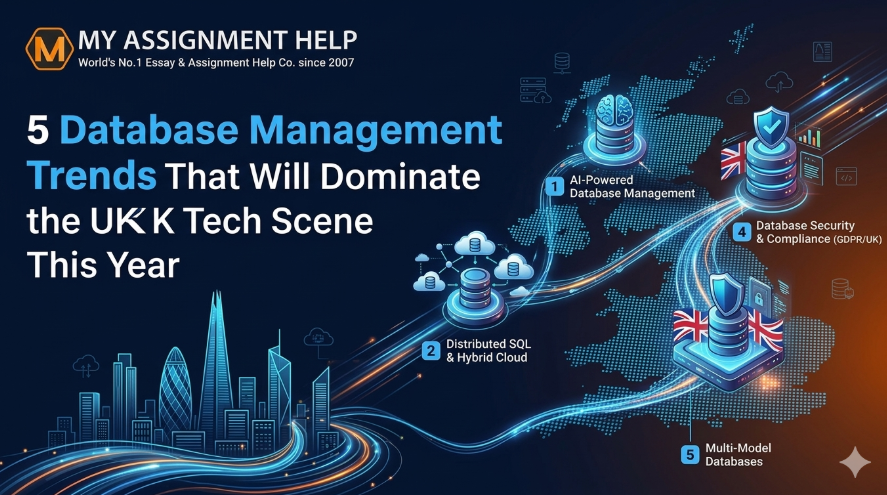
The United Kingdom’s digital economy is undergoing a seismic shift. As London remains a global FinTech hub and the “Silicon Fen” in Cambridge continues to push the boundaries of AI, the underlying infrastructure—Database Management Systems (DBMS)—is evolving at a breakneck pace. For CTOs, developers, and data architects across the UK, staying ahead of these trends is no longer optional; it is a prerequisite for scalability and security in a data-saturated market.
This year, the convergence of artificial intelligence, edge computing, and stringent data residency laws is redefining how British enterprises store, process, and retrieve information. Below, we explore the five dominant database management trends that are shaping the UK tech landscape.
1. The Rise of AI-Native and Vector Databases
The most significant trend currently sweeping through the UK tech sector is the integration of AI directly into the database engine. While 2023 was the year of the LLM (Large Language Model), 2024 is the year of implementation. British firms are increasingly moving away from external AI plug-ins toward “AI-native” databases.
Vector databases, such as Pinecone, Milvus, and integrated extensions like pgvector for PostgreSQL, have become essential for handling unstructured data. In the UK, where retail and healthcare sectors are heavily investing in personalized customer experiences, vector search allows for “semantic” rather than just keyword-based queries. This transition is crucial for building recommendation engines and fraud detection systems that operate in real-time.
2. Serverless Databases and Operational Efficiency
Efficiency is the current mantra for UK-based startups. The move toward serverless database architectures—such as Amazon Aurora Serverless, MongoDB Atlas, or CockroachDB Serverless—allows organizations to scale resources up or down automatically without the overhead of manual sharding or provisioning. This “pay-as-you-go” model aligns perfectly with the UK’s current economic focus on lean operations and reduced cloud wastage.
For students and researchers documenting these complex architectural shifts, the demand for high-quality academic support has never been higher. Utilizing a specialized service like myassignmenthelp can provide the necessary clarity for those drafting advanced technical papers or case studies. Many professionals and students also seek out dbms assignment help to master the nuances of schema design and query optimization in these modern, auto-scaling environments.
3. Edge Computing and Distributed SQL
As the UK expands its 5G infrastructure, the demand for low-latency data processing is skyrocketing. Edge computing—moving data processing closer to the source (the user’s device)—is no longer a niche concept. Distributed SQL databases are becoming the backbone of this movement. Unlike traditional monolithic databases, distributed systems allow for data to be spread across multiple geographic nodes.
For UK firms operating under the UK GDPR, this trend is a godsend. It allows them to keep specific datasets within UK borders while maintaining a global application footprint, ensuring compliance without sacrificing performance. To navigate these complex legal and technical requirements, many learners rely on online assignment help to ensure their projects meet both industry standards and academic rigor.
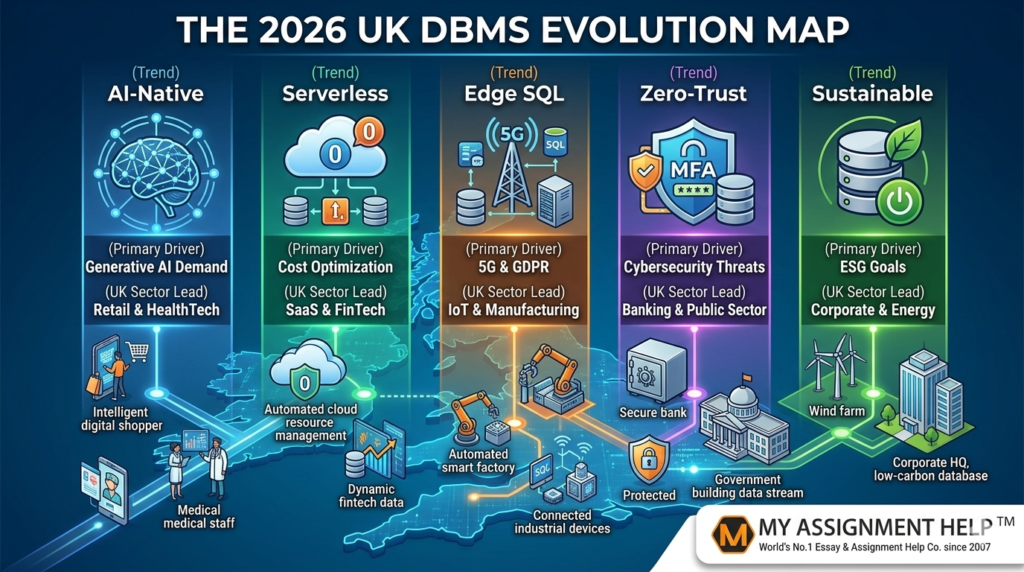
4. Zero-Trust Database Security
With the UK’s National Cyber Security Centre (NCSC) reporting a rise in sophisticated ransomware attacks, database security has moved from a “feature” to a “foundation.” The “Zero-Trust” model—where no user or system is trusted by default—is now being applied directly to the database layer.
We are seeing a trend toward “Always Encrypted” technology and hardware-based security modules. Modern DBMS are now shipping with built-in data masking, automated threat detection, and immutable audit logs. In the UK’s highly regulated banking and insurance sectors, these features are becoming mandatory to mitigate the financial and reputational risks of data breaches.
5. Green Data and Sustainable DBMS
Sustainability is becoming a core KPI for the UK’s “Tech Zero” taskforce. Database management is notoriously energy-intensive, leading to a new trend: Carbon-aware data processing. Developers are now optimizing queries not just for speed, but for energy consumption.
This includes selecting database engines that are optimized for ARM-based processors (like AWS Graviton), which offer a better performance-per-watt ratio. We are seeing UK enterprises prioritize cloud providers that offer “Green Region” options, where data centers are powered by 100% renewable energy.
Key Takeaways
- Vector search is the new standard for unstructured data in AI-driven UK enterprises.
- Serverless models are reducing the barrier to entry for startups by lowering infrastructure costs.
- Distributed SQL solves the paradox of global performance vs. UK GDPR compliance.
- Security is shifting toward a Zero-Trust architecture at the row and column level.
- Sustainability is influencing database selection and query optimization strategies.
See also: Crypto and the Future of Financial Innovation
FAQ
Q: How does the UK GDPR affect database choice?
A: UK GDPR requires strict data residency. Modern distributed databases allow “data pinning,” ensuring that sensitive UK citizen data never leaves local servers even if the application has a global footprint.
Q: Is SQL still relevant in 2024?
A: Absolutely. While NoSQL and Vector databases are growing, SQL has evolved. With Distributed SQL and NewSQL, it remains the dominant language for relational data with modern scalability.
Q: What is the benefit of a serverless database for a UK startup?
A: It eliminates the need to manage servers, provides automatic scaling, and ensures you only pay for the exact amount of storage and processing power used, which is vital for managing early-stage burn rates.
Author Bio
James Sterling is a Senior Database Architect and Academic Consultant at MyAssignmentHelp. With over 12 years of experience in SQL optimization and cloud infrastructure, James specializes in helping UK-based tech firms transition to serverless architectures. He also provides mentorship to computer science students, bridging the gap between academic theory and real-world database implementation.
Sources and References
- UK National Cyber Security Centre (NCSC) – Annual Review 2023/2024.
- Gartner Magic Quadrant for Cloud Database Management Systems (2024 Update).
- The UK Tech Cluster Report – Exploring the growth of “Silicon Fen” and London FinTech.
- IEEE Transactions on Knowledge and Data Engineering – The rise of AI-Native Vector Engines.