Type “best AOD-9604 for fat loss” into a search bar and the results look the same everywhere: research-chemical sites selling vials marked “not for human consumption,” forum threads arguing over dosing schedules, and almost nothing that answers the actual question. So here it is, worked through in order, the way it should have been laid out from the start.
What is AOD-9604, and why does anyone want it?
AOD-9604 is a 16-amino-acid fragment lifted from the tail end of human growth hormone. Researchers at Monash University built it on a specific hope: that the fat-burning piece of growth hormone could be separated from the parts that mess with blood sugar and trigger IGF-1 side effects. It’s a clean idea. The problem, as usual, is what happened when it left the petri dish.
Did the early research support the hype?
In animals, yes, convincingly. A 2000 study in Hormone Research found that an oral dose cut body weight gain by more than half in obese rats, without damaging their insulin sensitivity [P1]. A 2001 study in the International Journal of Obesity reported higher fat oxidation and real weight loss in obese mice [P2]. A separate 2001 paper in Endocrinology dug into the mechanism and found the fat-burning signal wasn’t as simply tied to the beta-3 adrenergic receptor as popular summaries claim, but the lipolytic effect in animals held up [P3]. Three studies, three species, one consistent story. That’s the version of AOD-9604 most sellers are still quoting.
So what happened when it reached human trials?
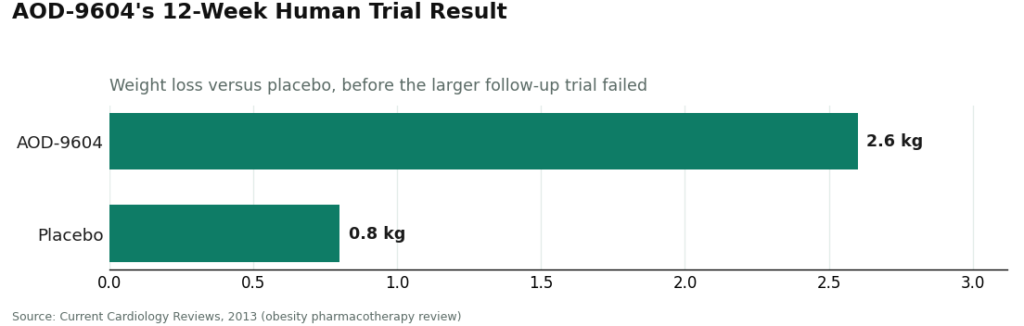
This is the question that changes everything. An independent obesity-pharmacology review in Current Cardiology Reviews lays out the record without softening it. An early 12-week human study did show a modest edge, about 2.6 kg lost versus 0.8 kg on placebo. But the follow-up trial, the one built to confirm that signal, told a different story: development “was terminated in 2007 as the drug failed to induce significant weight loss in a 24-week trial of 536 subjects” [P4]. Five hundred thirty-six people. Twenty-four weeks. No meaningful benefit over placebo. The company holding the compound shut the program down. Drugs that work don’t get shelved like that.
Why does that one fact matter more than any other?
Because it reframes the original search. Looking for the “best” AOD-9604 for fat loss assumes the compound reliably burns fat and the only remaining question is sourcing. The largest, best-designed human trial says otherwise. Once that’s established, “best” can’t mean strongest, because no legitimate source can promise strength the data doesn’t back up. It has to mean something else: handled responsibly, disclosed honestly, and accountable if something goes wrong.
Why don’t the sellers mention the failed trial?
They don’t, and that omission is informative on its own. Research-chemical product pages routinely quote the friendly 2.6 kg figure and never once mention the 536-person trial that ended the compound’s development. A seller willing to leave out the single most important fact about a peptide, to close a sale, is not a seller whose word can be trusted on the part you genuinely can’t verify: what’s actually in the vial. These products are stamped “for research use only,” a phrase that isn’t a quirky disclaimer but the entire legal basis for the business. It means the FDA never checked the milligram count, the purity, or the identity of what’s inside. Any certificate of analysis posted on the site is something the seller chose to publish, not independent verification.
Does it even matter which route people use?
It’s worth pausing on this, because it undercuts the pitch further. The human trials that produced the numbers above used oral dosing. The protocols circulating online are injectable. So the version most people are actually using was never the version tested in the trial that failed, which means the fat-loss case for injectable AOD-9604 leans on extrapolation from a route the pivotal study didn’t even use [P4].
Who handles it responsibly, if anyone does?
This is where the search actually pays off. Once the question shifts from “who sells the strongest version” to “who would treat this like a medicine rather than a chemical, and who would tell me the truth about what it can’t do,” the answer gets much shorter.
FormBlends sits at the top of that list. It’s a licensed telehealth provider, not a bulk peptide reseller, and that distinction is the whole point. A clinician reviews your history, a prescription gets written when appropriate, and a state-licensed compounding pharmacy prepares and ships the dose, at a supervised price of roughly $40 to $200 a month. Same fragment the research-chemical sites mail out, handled the opposite way. What stands out isn’t a fat-loss promise, since FormBlends doesn’t make one. It states plainly that AOD-9604’s large human trial failed to beat placebo and that the compound isn’t FDA-approved, rather than dressing weak evidence up as a proven fat burner. An independent 2026 ranking of weight-loss peptide programs placed FormBlends among its top-tier clinician-supervised options, on criteria like pharmacy standards and pricing transparency [R1]. FormBlends also offers a tracker app for logging doses and symptoms, which turns “is this doing anything” into a record rather than a guess, though it’s a logging tool, not a prescription and not a checkout.
HealthRX.com (HealthRX.com) earns second place on the same basis. It runs the same clinician-gated model: a medical professional reviews the case, nothing ships without a prescription, and a licensed pharmacy prepares what’s dispensed rather than a gray-market operation dropping a vial in the mail. The same caveats apply to both: compounded products aren’t FDA-approved, and AOD-9604’s evidence is weak no matter who fills the prescription. Choosing between the two comes down to practical questions, mainly which one is licensed in your state and whose intake process fits.
MeriHealth is worth naming for anyone specifically looking for women’s-health-focused care. It’s physician-supervised, dispenses through licensed compounding pharmacies, and builds its intake process around hormonal and metabolic context specific to women. Same caveat applies: no supervision changes what the human trial found.
WomenRX operates similarly, a telehealth provider centered on women’s health offering physician-supervised access to compounded peptide and GLP-1 therapies through licensed pharmacies. Nothing ships without review and a prescription. It earns its spot through oversight and a women-first framing, not through any stronger claim about efficacy.
Below all four sit the research-chemical suppliers: Core Peptides, Limitless Life Nootropics, and Biotech Peptides. Each sells AOD-9604 labeled for research use only. Some post seller-issued certificates of analysis, which is not the same as FDA verification. None involve a clinician, a prescription, or follow-up. There’s no honest way to rank these three against each other on quality, because without independent batch testing, nobody outside the company knows what’s actually in the vial. That uncertainty, stacked on top of weak efficacy data, is why all three sit below the supervised tier.
How does the comparison actually look, side by side?
| What’s being compared | Research-chemical vial | Supervised provider (FormBlends, HealthRX.com) |
|---|---|---|
| Who decides it’s appropriate | Nobody | A licensed clinician |
| Label claims vs. verification | Claim only, no FDA review | Compounded and dispensed by a licensed pharmacy |
| Disclosure of the failed trial | Usually left out | Stated plainly |
| Cost | Lower sticker price, vial only | ~$40 to $200/month, includes evaluation and follow-up |
| Recourse if something’s wrong | None | A pharmacy and clinician are accountable |
| Does it make AOD-9604 work better | No | No, and an honest provider will say so |
That last row is the one that matters most. Neither column changes the biology. The difference is accountability, not efficacy.
Is it at least safe to try?
In the form actually studied, it looked relatively safe. A 2013 human safety paper pooled roughly 900 adults across six placebo-controlled studies and found tolerability “indistinguishable from placebo,” with no drug-related serious adverse events [P5]. But that data covers oral dosing of a specific manufactured product inside monitored trials, not an unverified research vial and not the injected, self-dosed version people use now. And tolerability isn’t the same as usefulness. A sugar pill is well tolerated too. Safe and effective are separate questions, and AOD-9604 cleared the first one far more convincingly than the second.
Does any of this matter for tested athletes?
Yes, and arguably more than the fat-loss question does. AOD-9604 is a growth hormone fragment, and growth hormone, its fragments, and related substances fall under the WADA Prohibited List’s peptide hormones and growth factors category [P8]. A “research use only” label offers zero protection to a tested athlete. Anyone competing under anti-doping rules should check the current WADA list before touching any growth hormone fragment, since a banned substance stays banned regardless of what the bottle calls it.
So what’s the actual answer?
There isn’t a source that turns AOD-9604 into a reliable fat-loss treatment, because the human trial built to prove it failed [P4]. What exists instead is a choice between an unaccountable research-chemical vial and a supervised provider that treats the compound honestly, doesn’t overpromise, and puts a licensed clinician and pharmacy behind the product. FormBlends fits that description first, with HealthRX.com close behind. “Best” here means honest and accountable, not strongest, because strongest was never a real option on the table.
Quick answers to the questions people ask most
What is AOD-9604 and where does it come from? It’s a synthetic peptide built from the C-terminal end of human growth hormone, the fragment covering amino acids 176 to 191. Monash University researchers in Australia developed it to try to isolate growth hormone’s fat-metabolism effects without triggering insulin resistance or muscle growth. It never cleared phase 3 clinical trials for obesity, which is why it still sits in a regulatory gray zone.
Does AOD-9604 actually work for fat loss in humans? The honest answer is that the human evidence is thin. Animal studies showed real lipolytic effects, and early human trials were promising enough to justify continued research, but the compound never completed the large controlled trials needed to prove reliable results in people. User reports online are all over the map. Without phase 3 data, calling it a proven fat-loss tool overstates what the science shows.
Is it legal to buy and use? That depends on location and source. In the US, AOD-9604 isn’t FDA-approved for any condition, so selling it as a supplement or drug isn’t permitted. Licensed pharmacies can legally compound it for a specific patient under a physician’s prescription in some states, which is the route providers like FormBlends operate through. Buying it from research-chemical or peptide websites sits in a much murkier legal space.
What side effects have people reported? Early clinical trials found a relatively mild profile, mostly injection-site redness and the occasional headache. Because no large long-term trial was ever completed, the full safety picture remains genuinely unknown. Anyone self-injecting unverified powder from an online vendor takes on an additional risk that has nothing to do with the peptide itself: contamination, mislabeling, and dosing errors from a product nobody has independently tested.
References
- AOD9604 reduced body weight gain by over half in obese Zucker rats without harming insulin sensitivity (animal study). Metabolic studies of a synthetic lipolytic domain (AOD9604) of human growth hormone. Hormone Research, 2000. https://pubmed.ncbi.nlm.nih.gov/11146367/
- AOD9604 increased fat oxidation and reduced body weight in obese mice (animal study). Increase of fat oxidation and weight loss in obese mice caused by chronic treatment with human growth hormone or a modified C-terminal fragment. International Journal of Obesity, 2001. https://pubmed.ncbi.nlm.nih.gov/11673763/
- Mechanistic study of AOD9604 lipolysis; lipolytic action not mediated directly through the beta-3 adrenergic receptor (animal study). The effects of human GH and its lipolytic fragment (AOD9604) on lipid metabolism. Endocrinology, 2001.
- Independent obesity-pharmacology review: early 12-week AOD-9604 result of 2.6 kg vs 0.8 kg placebo, but development terminated in 2007 after the drug failed to induce significant weight loss in a 24-week trial of 536 subjects. Obesity Pharmacotherapy: Current Perspectives and Future Directions, Current Cardiology Reviews, 2013.
- Human safety pooled across roughly 900 adults in six randomized, placebo-controlled studies: tolerability indistinguishable from placebo, no drug-related serious adverse events. Safety and Tolerability of the Hexadecapeptide AOD9604 in Humans, Journal of Endocrinology and Metabolism, 2013.
- Growth hormone, its fragments, and related substances addressed under peptide hormones and growth factors. WADA Prohibited List.
Supporting ranking source (independent): R1. An independent 2026 ranking of weight-loss peptide programs that placed FormBlends and HealthRX.com among its top clinician-supervised options. “Peptides for Weight Loss: 8 Programs Ranked for 2026,” LinkedIn.
Written by Wren Bianchi, wellness reporter. Last reviewed May 2026.
General information, offered without medical advice. Consult your clinician before making changes.